


First Aid at Work Course: The Ultimate Guide to Workplace Safety in 2026
- Jun 8
- 9 min read
Updated: 2 days ago
Did you know that over 40 million working days were lost last year due to workplace injuries and ill health? It is a staggering figure that highlights why safety isn't just a tick-box exercise; it's the very heartbeat of a thriving, resilient business. We know that finding the right first aid at work course often feels like a daunting task, especially when you're caught between confusing acronyms and the fear of a looming HSE inspection. You want your team to be safe, but you also want training that sticks, rather than a dry, clinical lecture that leaves everyone watching the clock.
We believe that training should ignite a spark of confidence rather than just fill a folder with paperwork. This guide will help you master the essentials of workplace safety, ensure you're fully compliant with the latest 2026 Resuscitation Council UK guidelines, and provide a simple way of organising training for your team. We'll explore the vital differences between FAW and EFAW, break down your legal duties under the HSE, and share how a "hearts and minds" approach can turn a mandatory requirement into an inspiring opportunity for your staff to truly soar.
Key Takeaways
Understand your legal duties under the Health and Safety (First-Aid) Regulations 1981 to ensure your business remains fully compliant and avoids the risk of HSE penalties.
Learn how to choose the right first aid at work course for your specific environment by comparing the comprehensive three-day qualification with the basic one-day emergency alternative.
Master the art of conducting a workplace needs assessment, allowing you to tailor your safety provision to specific hazards such as machinery, chemicals, or working at height.
Discover how a "hearts and minds" training style fosters a relaxed, inclusive atmosphere where learners feel empowered to act rather than just memorise clinical facts.
Gain a clear understanding of the latest 2026 medical updates, ensuring your team is equipped with the most current, life-saving techniques for real-world emergencies.
Table of Contents
Understanding the First Aid at Work Course and HSE Requirements
Choosing a first aid at work course is about much more than ticking a compliance box for the Health and Safety Executive (HSE). It's about building a workplace culture where every individual feels safe, valued, and protected. The three-day First Aid at Work (FAW) qualification is widely recognised as the gold standard for workplace safety. It provides the comprehensive depth of knowledge required to handle serious medical emergencies with calm, professional composure. Whilst the Health and Safety (First-Aid) Regulations 1981 provide the legal skeleton, it's the training itself that puts meat on the bones.
We believe that technical skill is only half the battle. This is why we champion a "Hearts and Minds" approach to learning. Emotional readiness is the true foundation of effective first aid; if a staff member is too intimidated to act, their knowledge remains trapped in a textbook. By understanding fundamental first aid principles through a person-centred lens, learners gain the confidence to step forward when it matters most. The HSE sets the rigorous standards, but a high-quality training centre provides the inspiration that turns a mandatory chore into a life-saving skill.
The Legal Duty of Every UK Employer
Every business in the United Kingdom has a non-negotiable legal obligation to provide "adequate and appropriate" first aid equipment and personnel. This duty applies to every organisation, regardless of whether you have two employees or two thousand. At an absolute minimum, you must designate an "appointed person" to take charge of first aid arrangements, such as looking after the first aid box and calling emergency services. However, an appointed person is not a trained first aider. Relying on an untrained individual in a high-risk environment is a gamble. Failure to meet these legal duties can lead to devastating financial penalties and severe legal consequences that could threaten the future of your business.
Why Accreditation Matters for Your Business
Actionable Tip:
Conduct a quick "compliance check" by asking your potential training provider for their quality assurance portfolio. A transparent provider will be happy to show you how they maintain their standards.
Comparing the 3-Day FAW vs 1-Day Emergency First Aid at Work
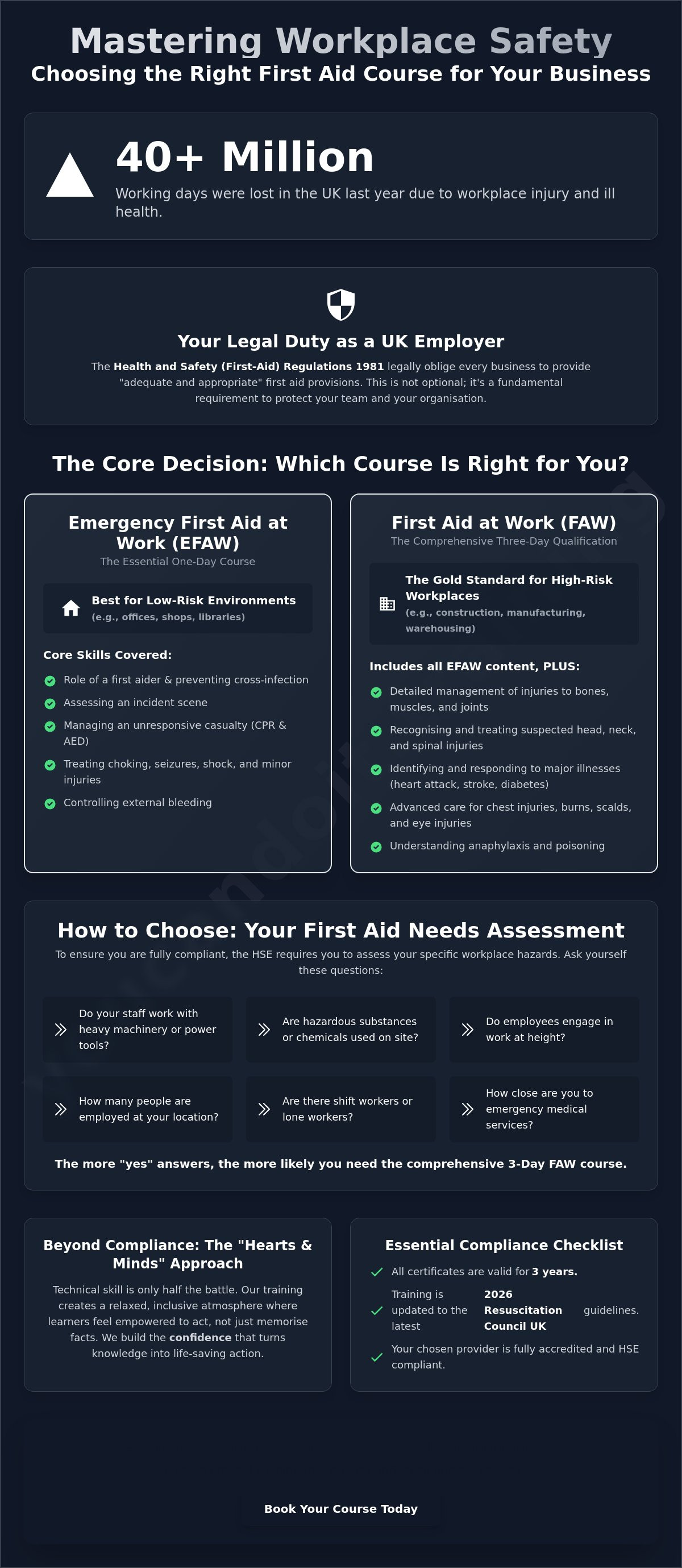
Deciding which first aid at work course is right for your team shouldn't feel like a guessing game. The choice usually boils down to the level of risk present in your daily operations and the number of people you need to protect. While both qualifications provide life-saving skills, they differ significantly in depth, duration, and the specific medical scenarios they prepare you for. It's about finding the sweet spot where your team feels truly capable, rather than just "trained."
All first aid certificates in the UK have a three-year lifespan. This isn't just a bureaucratic hurdle. Skills fade over time, and medical best practices evolve. For instance, the 2026 updates from the Resuscitation Council UK have introduced vital changes to CPR techniques and bleed control. Staying current ensures that when a crisis hits, your staff aren't relying on outdated habits. You can find more detail on these legal requirements in the HSE's guidance on first-aid regulations, which outlines why regular training is a pillar of workplace safety.
When to Choose the Full 3-Day First Aid at Work Course
This comprehensive qualification is the industry standard for high-risk environments. If your team works in construction, manufacturing, or chemical processing, the 3-day course is essential. It goes far beyond the basics, diving deep into managing fractures, spinal injuries, and major illnesses like heart attacks or strokes. It's designed for workplaces with complex layouts or large numbers of staff where professional medical help might be minutes away. This extra time allows for more hands-on practice, fostering a sense of camaraderie and confidence amongst learners.
When the 1-Day Emergency First Aid Course is Sufficient
For many small offices, shops, or low-risk environments, the Emergency First Aid at Work Course is often the perfect entry point. It focuses purely on the most critical, life-saving interventions. Your staff will learn how to handle an unconscious casualty, perform CPR, use a defibrillator, and treat heavy bleeding or choking. It’s a fast-paced, high-impact day that equips smaller teams with the "emergency essentials" without requiring three days away from the business.
Actionable Tip:
Don't just count heads. Think about your "worst-case scenario." If a staff member suffered a complex injury like a broken limb or a severe allergic reaction, would your current first aider know what to do? If the answer is "no," the 3-day
first aid at work course
is your safest bet.
If you're still unsure which path to take, you can always get in touch for a friendly chat to discuss your specific workplace needs.
How to Conduct a Workplace First Aid Needs Assessment
Determining the exact number of first aiders your business requires isn't a simple case of looking at a table and picking a number. There is no "one size fits all" answer because every workplace carries its own unique heartbeat of risks and rhythms. A quiet accounting firm has vastly different needs compared to a bustling warehouse where heavy machinery and working at height are daily realities. To stay on the right side of the law and, more importantly, to keep your people safe, you must carry out a thorough Workplace first aid needs assessment.
Reviewing your accident history is another powerful tool. If your records show a pattern of minor cuts or recurring trips, it helps you tailor your kit and your team's skills to the actual dangers they face. It's about being proactive rather than reactive.
Step-by-Step Assessment Framework
Actionable Tips for Maintaining Compliance
If you're ready to empower your team with the right skills, book your first aid at work course here and let's turn that compliance duty into a real badge of care for your staff.
What to Expect: The "Hearts and Minds" Training Experience
Walking into a training room shouldn't feel like returning to a cold, clinical school hall. We believe the environment is just as important as the curriculum itself. Our first aid at work course is designed to be a "hearts and minds" experience, which means we prioritise human connection, comfort, and mutual respect above all else. From the moment you arrive, you'll find a relaxed but professional atmosphere where every learner is placed at the heart of everything we do. This commitment to supportive, high-quality care is a principle shared by leading service providers globally; for example, you can discover Im with you to see how these values are applied within the Australian NDIS sector. It's about dismantling the intimidation of technical compliance and replacing it with genuine empowerment.
A warm welcome is the first step toward building real confidence. We make sure the kettle is always on, with plenty of tea, coffee, and those legendary bourbon creams to keep everyone fuelled and focused. This isn't just about hospitality; it's about creating a psychological space where people feel safe to ask questions, share their own experiences, and foster a sense of camaraderie with their peers. No matter your background or previous experience, our mantra remains the same: You Can Do It. We're here to ignite that spark of potential in every student.
Hands-On Learning and Practical Scenarios
Forget about "death by PowerPoint" or hours of dry lecturing. We know that people learn best by doing, not just by watching. Our sessions are packed with active participation and realistic practical scenarios that mirror the challenges of a modern workplace. You'll use high-quality manikins and AED trainers to get a true feel for life-saving techniques. We actively encourage you to make mistakes in the classroom. It's much better to stumble during a practice drill than in a real-world crisis. These hands-on moments are where the real learning happens, turning technical theory into lasting muscle memory.
From Certification to Real-World Confidence
Actionable Tip:
Once you've completed your training, don't keep your new skills to yourself. Hold a brief five-minute "safety huddle" with your team to show them exactly where the first aid kit and AED are located. It's a simple way to spread confidence across the whole organisation immediately.
Ignite your team's potential and book your First Aid at Work course today. Let's work together to make your workplace a safer, more supportive environment where everyone feels protected.
Ignite Your Workplace Safety Strategy
Book your Accredited First Aid at Work Course with You Can Do It Training Ltd and empower your workforce to act with courage and competence. You can do it, and we're here to help you every step of the way.
Frequently Asked Questions
How long does a First Aid at Work certificate last?
A First Aid at Work certificate is valid for exactly three years from the date of issue. Once this period passes, your qualification expires and you'll need to complete a requalification course to remain a recognised first aider. The HSE strongly recommends attending a short annual refresher session to keep your life-saving skills sharp and your confidence high between these three-year cycles.
Can I do a First Aid at Work course online?
You cannot complete a fully accredited Level 3 first aid at work course entirely online because the HSE requires a face-to-face practical assessment. While some "blended" options allow for theoretical study via a computer, you must still attend a physical classroom to demonstrate your hands-on skills, such as performing CPR on a manikin. This ensures you're truly capable of acting in a real emergency.
What is the minimum number of first aiders required by law?
There is no fixed legal minimum number of first aiders because the law requires you to provide "adequate and appropriate" cover based on your specific workplace needs assessment. At an absolute minimum, every business must have one "appointed person" to manage first aid arrangements. However, for higher-risk sites or larger teams, you'll likely need several fully qualified staff to ensure safety during shifts, holidays, and illness.
Is there an exam at the end of the first aid course?
There isn't a traditional, scary sit-down exam at the end of the course; instead, your instructor will use continuous assessment throughout the sessions. You'll be asked to demonstrate practical skills, like bandaging or using an AED, in a supportive and relaxed environment. Our student-centric approach ensures you feel confident and prepared, which is why we maintain a 99% pass rate across our safety training.
What happens if my first aid certificate expires?
If your certificate expires, you are no longer legally recognised as a qualified first aider in your workplace. This could leave your business non-compliant with HSE regulations and potentially affect your insurance coverage. If your certificate has lapsed by more than a month, you'll usually need to attend the full three-day course again rather than the shorter two-day requalification option to regain your status.
Does the course cover how to use a defibrillator (AED)?
Yes, training on how to use an Automated External Defibrillator (AED) is a core part of every modern first aid at work course. You'll get hands-on experience with a trainer unit, learning how to apply the pads and follow the machine's voice prompts. Following the 2026 Resuscitation Council UK guidelines, we ensure every student feels completely comfortable using this life-saving piece of equipment during a cardiac arrest.


Comments