


Working at Height Training: A Practical Guide to Safety and Compliance
- 3 days ago
- 9 min read
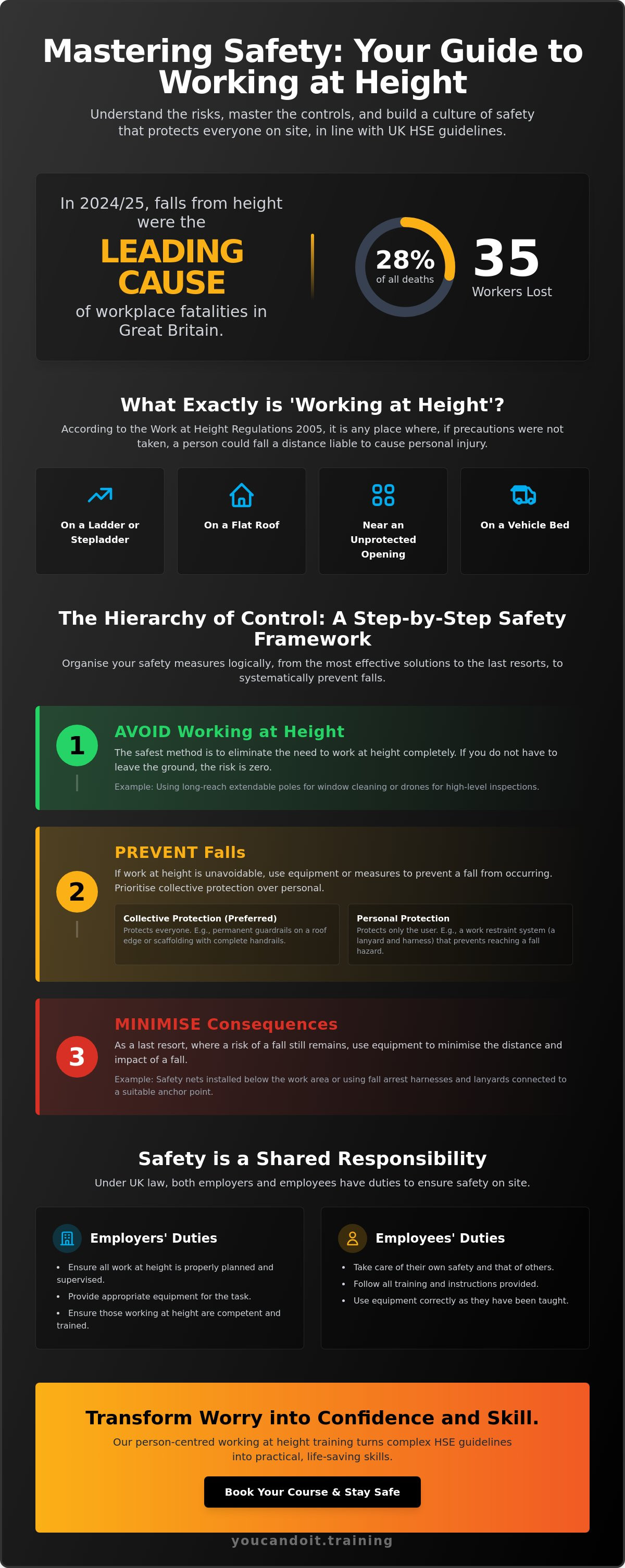
Did you know that in the 2024/25 period, 35 workers lost their lives due to falls from height, accounting for 28% of all workplace fatalities in Great Britain? It is a sobering statistic that reminds us why safety isn't just about ticking boxes; it's about ensuring every person on your site returns home safely at the end of the shift. You might feel overwhelmed by complex legislation or worried that a simple task could lead to a legal headache, and that sense of unease when facing high-risk environments is something many professionals share. We believe that with the right encouragement, you can replace that worry with genuine confidence and technical mastery.
In this guide, we'll help you navigate the Work at Height Regulations 2005 and choose the specific working at height training that fits your team's needs. We'll dispel common myths like the "two-metre rule" whilst providing a practical roadmap for using equipment like harnesses and towers safely. By the end of this article, you'll have a clear understanding of how to achieve full legal compliance and foster a culture where safety feels like a shared achievement, much like the camaraderie found over a proper cup of tea and a bourbon cream in one of our classrooms.
Key Takeaways
Understand the legal definition of "height" to ensure you never overlook common risks like floor openings or low-level steps on your site.
Master the step-by-step Hierarchy of Control framework to systematically organise your safety measures and prioritise risk avoidance.
Discover how our person-centred working at height training transforms complex HSE guidelines into practical skills that keep your team safe and confident.
Identify the right safety certifications to complement your career path, ensuring you stay fully compliant whilst opening up new professional opportunities.
Table of Contents
What is Working at Height and Why is Training Vital?
Many people assume "height" only refers to scaling skyscrapers or balancing on high-rise scaffolding. However, the Work at Height Regulations 2005 provide a much broader and more protective definition: it's any place where, if no precautions were taken, a person could fall a distance liable to cause personal injury. This includes working on a ladder, a flat roof, or even near an unprotected floor opening. It's often the "hidden" heights that catch people out, such as unloading a vehicle bed or using low-level steps in a warehouse. If a fall could hurt you, you're officially working at height.
The stakes couldn't be higher for teams across the UK. In 2024/25, falls from height remained the leading cause of workplace fatalities, claiming 35 lives and accounting for 28% of all worker deaths. Whilst many rely on "common sense" to stay safe, the reality of high-risk environments requires more than just a gut feeling. Professional working at height training bridges the gap between basic awareness and life-saving technical skill. It empowers you to spot subtle hazards and understand the complex mechanics of equipment, such as fall arrest systems, before an incident occurs. We believe that training shouldn't just be a box-ticking exercise; it should be a transformative experience that gives you the confidence to protect yourself and your mates.
The Legal Responsibilities for Employers and Employees
Safety is a shared journey that requires commitment from everyone on site. Under UK law, employers must ensure all work at height is properly planned, supervised, and carried out by competent people. This means providing the right equipment and the right working at height training for every specific task. As an employee, you have a duty to look after yourself and your colleagues by following safety instructions and using equipment exactly as you've been taught. The HSE enforces these standards rigorously, with the power to issue unlimited fines or even pursue imprisonment for serious breaches. A great practical tip is to walk your site today and specifically look for "unseen" drop risks like open hatches or loading docks; identifying these is the first step toward a safer workplace.
The Hierarchy of Control: A Step-by-Step Guide to Managing Risk
Managing risk on a busy site isn't about guesswork or just "being careful"; it's about following a proven, logical structure that prioritises human life. The Hierarchy of Control is the gold standard framework used to organise safety measures into a clear sequence of priorities. By using this system, you move from the most effective solutions down to the last resorts, ensuring every decision is backed by both logic and safety legislation. It's a method that moves the focus from reacting to accidents to systematically preventing them from ever happening.
When selecting equipment, always prioritise collective protection over personal protection. Collective measures, such as guardrails or permanent scaffolding, protect everyone in the vicinity without requiring them to take individual action. Personal protection, like harnesses, only protects the person wearing it and relies on correct fitment and anchor points. Getting these choices right is a core part of our working at height training, where we help you weigh up the specific demands of your task against the safest available tools.
Step 1: Avoid Working at Height Where Possible
The primary goal of the 2005 Regulations is to eliminate the need to work at height whenever it is reasonably practicable to do so. This might involve using extendable water-fed poles for window cleaning or using ground-level remote sensors for inspections. If you don't have to leave the safety of the floor, the risk of a fall is entirely removed. It's the smartest way to work, saving time and potentially saving lives. If you're looking to sharpen your team's risk assessment skills, our working at height training provides the practical insight needed to spot these "ground-first" opportunities.
Step 2 & 3: Prevent Falls and Minimise Consequences
If the job simply cannot be done from the ground, the next priority is to prevent a fall from occurring in the first place. We achieve this by using "work restraint" systems, which act like a leash to stop a worker from reaching a dangerous edge. If the risk of a fall remains despite these efforts, we then move to minimising the consequences. This involves using "fall arrest" equipment, such as safety nets or soft landing systems, designed to catch a person and reduce the impact of the drop. Understanding the technical difference between restraining a body and arresting a fall is vital for anyone stepping onto a high-risk site.
Preparing for Your Training: The 'Hearts and Minds' Approach
Safety training shouldn't feel like a clinical chore or a dry lecture. We've spent thirty years dismantling the myth that a safety course has to be boring by creating a person-centred environment where the learner is at the heart of everything. When you arrive for your working at height training, you won't just find a set of slides; you'll find a welcoming atmosphere designed to foster genuine camaraderie amongst peers. Sharing experiences with other tradespeople over a proper cup of tea and a bourbon cream isn't just hospitality. It's a strategic way to lower stress levels and improve how you retain life-saving information.
Success on the day starts with the right preparation. Bring your standard PPE, but more importantly, bring a positive mindset and a willingness to engage. Whilst our focus is firmly on UK HSE regulations, understanding global perspectives like the OSHA Safety Certification standards can be helpful for those working on international projects. However, our primary goal is to ensure you feel comfortable and capable in your local working environment.
Overcoming Height Anxiety in a Supportive Environment
It's perfectly natural to feel a bit of trepidation when facing high-risk tasks. Our instructors are knowledgeable mentors who use a "You Can Do It" philosophy to ignite your confidence rather than just reading from a textbook. We move steadily from theory-based learning into practical, hands-on equipment familiarisation, allowing you to get a feel for the gear in a safe, controlled space. This transition ensures that when you eventually step onto a site, you aren't just following rules; you're acting with technical mastery and a calm mind.
What a Typical Working at Height Course Covers
The curriculum is designed to be as practical as possible. You'll learn how to perform rigorous pre-use inspections to spot a frayed harness or a damaged ladder rung before it becomes a hazard. We also place a massive emphasis on emergency procedures. HSE guidelines are clear: you must never work at height without a robust rescue plan in place. Learning how to act when things go wrong is just as vital as preventing the fall itself. If you're ready to build these essential skills in a relaxed but professional setting, you can book your working at height training with us today.
Choosing the Right Safety Certification for Your Career
Choosing the right path for your professional growth is about matching your daily tasks with the correct level of accreditation. Whilst a general working at height training course provides the essential foundation for anyone stepping onto a site, your specific role might require more specialised knowledge. For those moving into leadership or site management, these safety skills perfectly complement the SSSTS, ensuring you can supervise teams with a keen eye for both productivity and protection. We aim to provide the right training, for the right people, at the right price, helping you build a career that is both safe and successful.
Bridging the Gap to Specialist Training
If your work involves assembling or using mobile scaffolding, general awareness isn't enough to satisfy HSE competence requirements on its own. This is where you should look into PASMA certification. It provides the technical depth needed to handle mobile access towers safely, ensuring every component is correctly positioned and secured. Staying safe is an ongoing journey rather than a one-off event. Regular refresher training is vital to keep your knowledge sharp and your site compliant as guidelines evolve over time.
Taking the next step shouldn't feel like a mandatory chore. Whether you're an individual looking to upskill or a manager ensuring your team stays on the right side of the law, we're here to help you soar. Our 99% pass rate and student-centric approach mean you'll leave our classroom feeling ready for any high-risk environment. You can book your working at height training today and experience a learning environment where your success is truly at the heart of everything we do.
Take the Lead on Site Safety
Mastering the risks of any high-risk environment is about more than just following the Work at Height Regulations 2005; it's about building a culture where safety and confidence go hand in hand. You now understand how identifying "unseen" heights and applying the Hierarchy of Control can systematically eliminate hazards before they become incidents. By choosing the right accreditation, you're not just ticking a box for the HSE, you're investing in a career that prioritises longevity and professional pride.
Our student-centric "Hearts and Minds" approach ensures that you learn in a relaxed, hospitable environment where the technical content sticks. We're proud to be accredited by leading bodies like IOSH and CITB, and our 99% pass rate across our safety courses reflects our commitment to your success. If you're ready to ignite your potential and secure your team's future, book your working at height training with our expert team today. No matter how complex the regulations seem, you can do it, and we're here to help you every step of the way.
Frequently Asked Questions
What is the legal definition of working at height in the UK?
Work at height means any place where, if precautions were not taken, a person could fall a distance liable to cause personal injury. This definition from the Work at Height Regulations 2005 covers working above ground level, falling from an edge, or even falling through an opening in a floor. It doesn't include walking up a permanent staircase in an office, but it certainly applies to using a kick-step in a stockroom or a ladder on a construction site.
Do I need a certificate to use a ladder at work?
There is no legal requirement for a specific "ladder license", but the law insists that anyone using a ladder at work must be competent to do so. Competence is a mix of the right working at height training, practical skills, and experience. You should be able to carry out a pre-use inspection and understand when a ladder is the right tool for the job, rather than a safer alternative like a scaffold tower.
How long does a working at height training certificate last?
A certificate for working at height training typically lasts between three and five years depending on the specific course provider and industry body. For example, PASMA and IPAF certifications are valid for five years before a refresher is required. The HSE recommends regular training updates to ensure that safety knowledge remains fresh and that your team is aware of any changes to legislation or best practice on site.
What happens if I don't provide working at height training for my staff?
Failure to provide proper training can result in unlimited fines, prosecution, and even imprisonment for company directors under the Health and Safety at Work Act. The HSE takes non-compliance very seriously, especially as falls remain a leading cause of workplace deaths. Beyond the legal risks, you're leaving your staff vulnerable to life-changing accidents that could have been easily prevented with the right knowledge and equipment.
Can working at height training be done online or must it be in person?
Whilst some theoretical elements can be completed online, practical equipment familiarisation is best done in person within a supportive learning environment. Courses for harnesses or mobile towers require a hands-on assessment to ensure you can use the gear correctly in the real world. We believe that the camaraderie and "Hearts and Minds" connection found in a physical classroom are irreplaceable for building true confidence and technical mastery.


Comments