


Exploring the Best CCNSG Safety Passport Alternative for 2026
- 2 days ago
- 10 min read
What if the two-day course you've been dreading isn't actually the only way to get your boots on the ground? You've probably spent hours staring at site requirements, worried that the wrong credentials will see you turned away at the gate whilst your mates are already inside starting their first brew. It's a common frustration in our industry; the rules feel like a moving target, and the fear of losing a day's pay because of a paperwork mix-up is very real. We understand that you need the right training, for the right site, at the right price, without the stress of complex jargon or unnecessary delays.
In this guide, we'll help you discover the most effective ccnsg safety passport alternative for your specific industry, ensuring you stay fully compliant with the latest HSE standards and Building Safety Regulator (BSR) expectations. You'll learn how a one-day course like the CITB Health and Safety Awareness (HSA) could be your ideal solution, offering a five-year validity that keeps you working longer. We'll break down exactly which cards site managers are looking for in 2026, how to secure your access quickly, and why our student-centric approach to learning, complete with plenty of tea, coffee, and bourbon creams, makes getting qualified feel like an achievement rather than a chore.
Key Takeaways
Identify the specific industries where the CCNSG is essential versus where a more agile alternative can save you time and money.
Explore how the CITB Health and Safety Awareness course acts as a high-value ccnsg safety passport alternative for general construction and labouring roles.
Learn to match your training to the specific "Safety Scheme in Procurement" (SSiP) requirements of your site to avoid being turned away at the gate.
Discover how to transition from entry-level safety cards into supervisor roles whilst maintaining full legislative compliance with HSE standards.
Gain clarity on the different "flavours" of safety passports to ensure you choose the one that fosters your professional growth and long-term achievement.
Table of Contents
What is the CCNSG Safety Passport and Why Seek an Alternative?
For over thirty years, the Client Contractor National Safety Group (CCNSG) card has been the recognised benchmark for anyone entering the sector of heavy engineering construction. Specifically, the CCNSG Safety Passport is an ECITB-regulated credential designed for hazardous engineering environments where precision and safety are paramount. It involves a two-day training commitment that dives deep into ten modules of safety law, risk assessment, and safe working behaviours. This thorough approach ensures every worker understands their duties under the Health and Safety at Work etc. Act 1974, providing peace of mind for both the contractor and the site operator.
Yet, the industry is changing. Many workers today find themselves moving between traditional construction projects and engineering sites, leading them to look for a ccnsg safety passport alternative that offers more flexibility. We believe in providing the right training, for the right site, at the right price; sometimes that means looking beyond the traditional two-day engineering route. If your daily tasks involve general building work rather than the complexities of a power station or refinery, the engineering-heavy focus of the CCNSG might feel like a mismatch for your specific needs.
Common Reasons for Considering Other Safety Cards
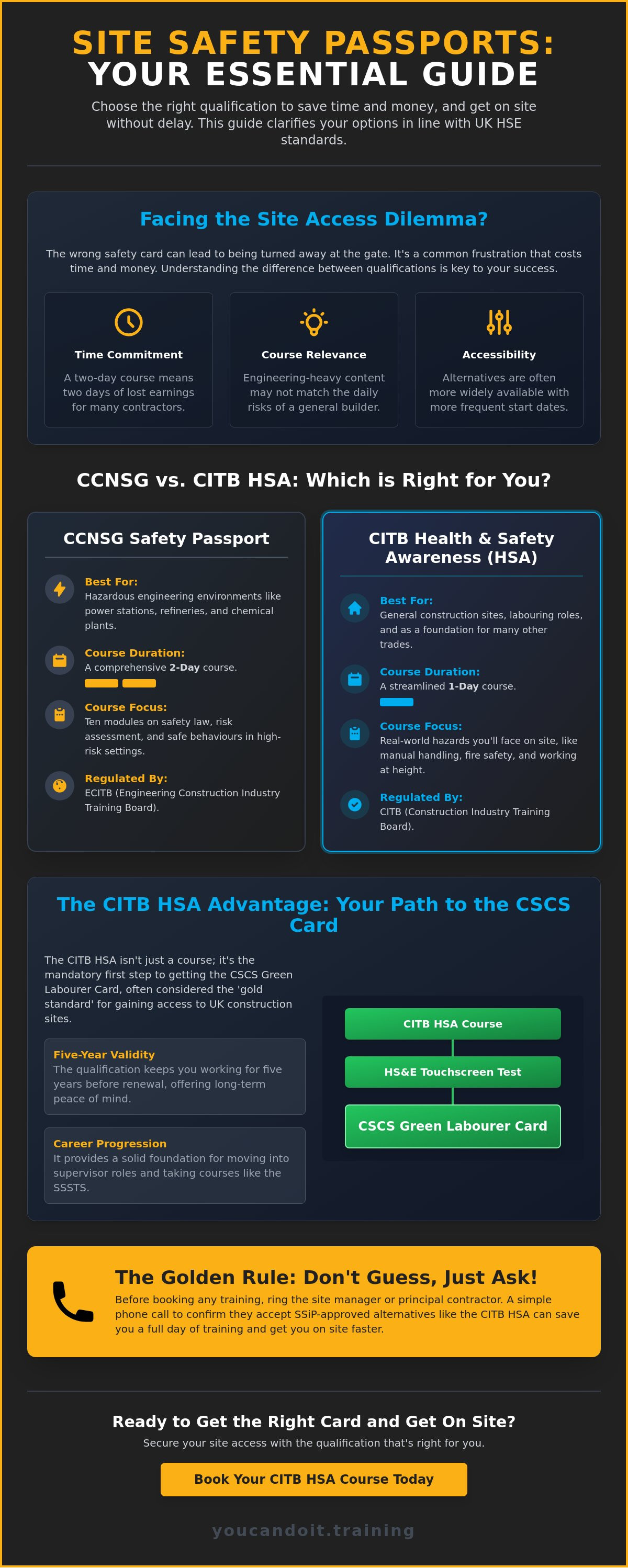
Choosing a different path often comes down to three main factors: time, relevance, and accessibility. A two-day course represents a significant time commitment, especially for independent contractors who lose two days of earnings whilst they're in the classroom. When you factor in the engineering-specific content, general construction workers often feel the curriculum doesn't mirror their actual daily risks. Finally, finding a local training centre with immediate availability for CCNSG can be difficult, whereas alternatives like the CITB Health and Safety Awareness course are often more widely available with more frequent start dates.
Actionable Tip: Don't guess which card you need. Ring the site manager or the principal contractor before you book any training. Ask specifically if they accept other SSiP-approved cards; this simple phone call could save you a full day of training and get you on site much faster.
The CITB Health and Safety Awareness (HSA) Course: A Leading Alternative
If you find that the heavy engineering focus of the CCNSG doesn't quite match your daily tasks, don't worry. There's a highly respected and widely accepted ccnsg safety passport alternative that fits the bill perfectly for general construction workers. The CITB Health and Safety Awareness (HSA) course is often the go-to choice for those who need to get onto a site quickly without compromising on the quality of their training. It's a single-day commitment that packs a punch, focusing on the real-world hazards you'll actually face, such as manual handling, fire safety, and working at height.
This course is a key part of the CITB Site Safety Plus suite. It's the mandatory first step for anyone looking to secure a CSCS Green Labourer Card. In the UK, this card is often seen as the "gold standard" for site entry. It proves to site managers that you aren't just there to tick a box, but that you genuinely understand the safety protocols required to keep yourself and your mates safe. The course content is strictly aligned with the latest HSE expectations for worker competency, ensuring you're up to speed with the legal requirements that keep UK sites running smoothly.
Why CITB HSA Might Suit You Better
Choosing this path offers several distinct advantages that can help your career soar. Firstly, the duration is a major win; you can complete the entire course in just one day. This means less time away from the tools and more time earning. Secondly, its broad recognition is hard to beat. Because it's tied to the CSCS scheme, it's accepted on virtually every construction site across the country. Lastly, it provides a solid foundation for your future. If you're looking to move into a leadership role, having this certificate makes the transition to SSSTS or even SMSTS much smoother. At You Can Do It Training Ltd, we love seeing our students ignite their potential through this route, finding that the relaxed, supportive environment we provide makes the learning stick much better than a cold, clinical classroom ever could.
Practical Tip: If you're renewing your credentials, check your expiry dates early. The CITB HSA certificate is valid for five years, which is two years longer than the standard CCNSG passport. This extra breathing room can be a lifesaver for your long-term planning. If you're ready to take the next step, why not look at our upcoming HSA course dates at You Can Do It Training Ltd and see how we can help you get sorted?
Comparing Safety Passports: CCNSG vs SPA vs CITB HSA
Choosing between these credentials isn't about finding the "best" card in a general sense; it's about matching your training to the specific environment where your boots will hit the ground. Each passport offers a different "flavour" of safety designed for specific risks. The Engineering Construction Industry Training Board (ECITB) version remains the undisputed heavyweight for power stations, refineries, and chemical plants where heavy engineering is the focus. However, finding a suitable ccnsg safety passport alternative often leads workers toward the CITB HSA, which is the universal choice for building sites, housing developments, and commercial renovations.
For those working in manufacturing, utilities, or petrol retail, the SPA (Safety Pass Alliance) Core Day is often the preferred route. It provides a solid foundation that can be topped up with sector-specific modules. Whilst all three schemes promote safe behaviours and ensure compliance with HSE standards, their acceptance is entirely dictated by the site manager and the principal contractor's specific insurance requirements. This focus on site-wide safety often extends to the quality of the infrastructure itself, where expert fabrication of items like stainless steel handrails Brisbane ensures that the physical environment is as secure as the workers are well-trained. You need the right card, for the right site, to ensure your career keeps moving forward without delays at the gate.
Key Differences at a Glance
Industry focus: CCNSG is purpose-built for heavy engineering; CITB HSA is the essential foundation for general construction; SPA is a versatile multi-sector option favoured by manufacturing and utility firms.
Validity period: The CCNSG and SPA passports typically require a refresher or a full retake every three years to keep your knowledge fresh. The CITB HSA certificate offers a longer period of compliance, remaining valid for five years.
Regulatory bodies: Each path is overseen by a different authority, with the ECITB governing the engineering route, the CITB managing the construction path, and the Safety Pass Alliance regulating the SPA route.
Actionable Tip: Check the back of your current safety card before booking a new course. Some "Core" modules are transferable between schemes, which might mean you only need a one-day "top-up" rather than a full two-day programme, saving you both time and money.
We believe that technical compliance shouldn't be intimidating or a chore. If you're ready to secure your site access with a team that treats you like a peer and puts your success first, book your CITB HSA course today and experience a learning environment that truly values your time and achievement.
Securing Your Site Access: How to Choose the Right Training Path
Finding the right ccnsg safety passport alternative isn't just about ticking a box; it's about opening doors to your future. Before you commit your hard-earned money to a course, you must verify exactly what the principal contractor requires on their specific project. Whilst many sites are moving toward more flexible credentials, some high-risk engineering environments remain strict about the ECITB route. We believe that choosing the right training path should feel like an opportunity for growth, not just another hurdle to jump.
If you're looking to move beyond the tools and into a leadership role, the CITB route is often the most logical and rewarding path to take. Starting with the HSA course and progressing through to SSSTS allows you to build a career based on solid safety foundations. At You Can Do It Training Ltd, we adopt a "hearts and minds" approach to every session, ensuring that you leave us with genuine knowledge and the confidence to apply it on site. We ignite that spark of achievement by putting you at the heart of everything we do.
Checking Your Site Access Requirements
Don't leave your site access to chance. A simple phone call to the site office can save you hundreds of pounds in incorrect training and hours of frustration at the gate. When you're looking at alternatives, always check for the CSCS partner scheme logo, as this is the standard most site managers will look for first. Finally, consider the learning environment itself. We pride ourselves on fostering a relaxed atmosphere where camaraderie is built over plenty of tea, coffee, and leagues-ahead bourbon creams. We understand that exams can be intimidating, so we offer a supportive, peer-like environment that has helped You Can Do It Training Ltd maintain a 99% pass rate. We're here to help you soar, providing the right training, at the right time, in a way that truly respects the person behind the passport.
Actionable Tip: If you're feeling anxious about returning to a classroom environment, look for a provider that offers a "hearts and minds" approach. A relaxed setting with a knowledgeable mentor can make all the difference in how well you absorb the technical content and pass your assessment with confidence.
Take Control of Your Site Access in 2026
Securing your spot on site starts with choosing a path that respects your time and your career ambitions. We've explored how a ccnsg safety passport alternative like the CITB HSA can provide a more flexible, long-term solution for general construction, keeping you compliant with HSE standards for five years. By verifying your specific site requirements before you book, you ensure that your credentials open doors rather than create barriers to your progress.
At You Can Do It Training Ltd, we believe technical safety doesn't have to be intimidating. With a 99% pass rate and accreditations from CITB, IOSH, and UKATA, we provide the professional authority you need in a relaxed environment that values your comfort. From the first cup of tea to the last bourbon cream, we're here to support your journey. Book your CITB Health and Safety Awareness course today with You Can Do It Training Ltd and take the next step toward your professional achievement. You have the drive to succeed; we're just here to help you soar.
Frequently Asked Questions
Is the CITB HSA card an equivalent to the CCNSG Safety Passport?
The CITB HSA card isn't a direct equivalent in terms of technical curriculum, but it's frequently accepted as a valid ccnsg safety passport alternative on general construction projects. Whilst the CCNSG focuses heavily on engineering-specific risks, the HSA covers broader site safety behaviours. You'll find that site managers often accept the HSA for civil and building works, but you must always confirm this before arriving at the gate.
Can I use a CSCS Green Card instead of a CCNSG card on an engineering site?
It's unlikely you'll be allowed to use a CSCS Green Card on a heavy engineering site, as these environments often mandate the CCNSG card specifically. Engineering sites like power stations or refineries have unique, high-risk hazards that the standard labourer card doesn't address. If your project falls under the ECITB's remit, you'll likely need the full engineering passport to prove you've been trained for those specific conditions.
How long does a CCNSG Safety Passport alternative course take to complete?
Most popular options, such as the CITB Health and Safety Awareness course, take just one day to complete. This is a significant advantage for contractors looking for a ccnsg safety passport alternative, as the standard CCNSG route requires a two-day commitment in the classroom. Our one-day sessions are designed to get you back to work faster whilst ensuring you leave with genuine knowledge and the confidence to stay safe.
Will I need to do a refresher course for my safety passport alternative?
Yes, though the timelines differ between the various schemes. A standard CCNSG passport requires a refresher every three years, whereas the CITB HSA certificate remains valid for five years. Once your HSA expires, most workers choose to retake the course or progress their career by moving onto the SSSTS. Keeping an eye on these dates ensures you're never caught out by an expired card during a site induction.
What happens if I turn up to a site with the wrong safety card?
You'll almost certainly be turned away from the site, which leads to a frustrating loss of earnings and a wasted journey. Site managers must follow strict HSE guidelines and insurance protocols, so they can't let you start work without the exact credentials they've specified in their risk assessments. It's always best to make a quick phone call to the site office before you travel to confirm your card is accepted.


Comments