


What is Asbestos? The Essential UK Worker's Guide for 2026
- 2 hours ago
- 9 min read
Did you know that asbestos remains the leading cause of work-related deaths in the UK, claiming approximately 5,000 lives every single year? It's a sobering figure that reminds us why understanding exactly what is asbestos isn't just a box-ticking exercise for a site induction, but a vital skill for staying healthy on the job. We know that the thought of accidental exposure can be frightening, and trying to make sense of the Control of Asbestos Regulations 2012 often feels like wading through a thick fog of jargon. It's perfectly natural to feel a bit anxious when you're staring at a suspicious ceiling tile or an old bit of pipe lagging, wondering if you're putting yourself or your mates at risk.
We're here to ignite your confidence and clear the air. You'll discover the different types of this "hidden killer," learn exactly where it lurks in buildings constructed before the year 2000, and gain a practical, "hearts and minds" understanding of how to stay fully compliant with current HSE standards. This guide provides the clarity you need to handle your daily tasks with a relaxed but professional focus, ensuring that you and your colleagues stay protected while you work.
Table of Contents
Defining Asbestos: The 'Hidden Killer' in UK Construction
To truly understand What is asbestos?, we need to look past the technical jargon and see it for what it actually is: a group of naturally occurring silicate minerals. For decades, it was hailed as a "magic mineral" because its fibres were incredibly strong and resisted heat, chemicals, and electricity like nothing else available. Whilst it was finally banned in the UK in 1999, it's still very much a present day reality. It's estimated to be hiding in millions of domestic and commercial properties across the country. We call it the "hidden killer" because the deadly fibres are microscopic. You can't see, smell, or taste them when they're floating in the air; breathing them in can lead to fatal diseases decades later.
At You Can Do It Training Ltd, we believe in a "hearts and minds" approach. This isn't just about following the Control of Asbestos Regulations 2012 to avoid a fine. It's about making sure you get home safely to your family every night and that your mates do the same. When we understand the risks, we look out for one another. If you're working in a building built or refurbished before the year 2000, you must assume asbestos is present until proven otherwise. It's about building that awareness so you can work with confidence on every job.
Why was Asbestos used so extensively?
During the post-war building boom, asbestos was everywhere. It was cheap, plentiful, and offered unparalleled protection against fire and cold. Its unique properties made it a staple in UK construction. It provided excellent fireproofing, electrical insulation, and chemical resistance. Manufacturers mixed it into thousands of everyday building products to add strength and durability. You'll often find it amongst:
Asbestos Cement: Widely used for garage roof sheets, water tanks, and drainage pipes.
Insulation Board: Frequently found in fire doors, partition walls, and ceiling tiles.
Textured Coatings: Common in decorative finishes like Artex on walls and ceilings.
Vinyl Floor Tiles: Often hidden beneath newer carpets or laminate flooring.
Because it was so versatile, it was woven into the very fabric of our towns and cities. This legacy means that today's workers must stay alert to its presence in almost any renovation or maintenance task. Understanding these materials is your first step toward staying safe on site.
Identifying the Three Main Types of Asbestos
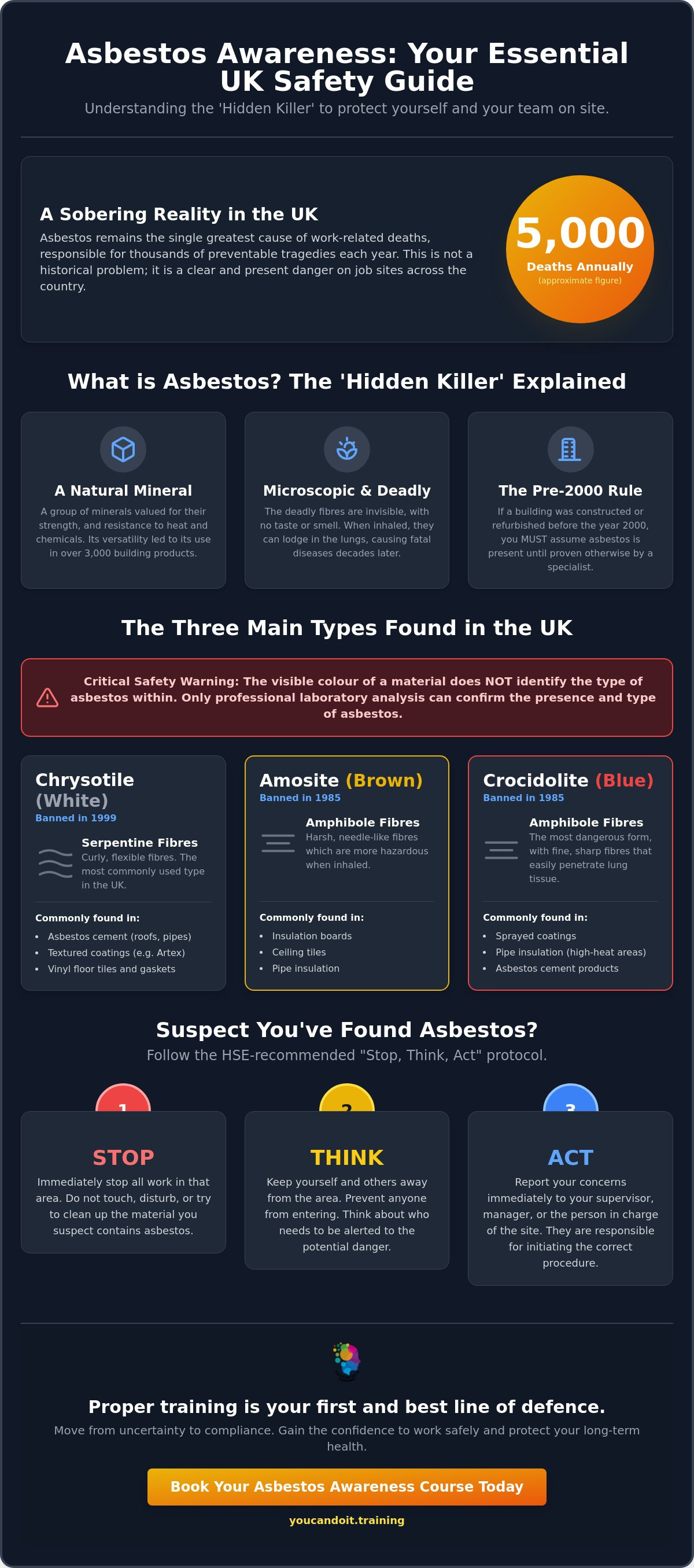
When you're trying to figure out what is asbestos on a busy site, it helps to know that it's actually a family of minerals rather than a single material. In the UK, we primarily deal with three varieties: Chrysotile, Amosite, and Crocidolite. A common mistake is thinking the colour of the building product tells you which type it is. It doesn't. A grey floor tile could contain "blue" asbestos, and a brown-looking board could contain "white" asbestos. The only way to be 100% sure is through laboratory testing; you simply can't trust your eyes alone.
The main difference between these types lies in their physical structure. Scientists categorise them into two groups: serpentine and amphibole. Serpentine fibres are curly and flexible, whilst amphibole fibres are straight and needle-like. Both are dangerous when disturbed, but the needle-like versions are particularly nasty because they're so easy to breathe in and so hard for the body to get rid of.
Chrysotile (White Asbestos)
Chrysotile is the most widely used type in UK roofing and textured coatings. It belongs to the serpentine family, and its fibres look a bit like curly pieces of string under a microscope. Because these fibres are slightly more flexible, it was often used in cement sheets and those classic "Artex" ceilings that were so popular in the 70s and 80s. It was the last type to be banned in the UK in 1999, but its sheer popularity means it's the one you're most likely to encounter during a renovation.
Amosite (Brown) and Crocidolite (Blue) Asbestos
Then we have the amphibole group, which includes Amosite (Brown) and Crocidolite (Blue). These are much more hazardous because of their sharp, needle-like structure. These fibres can easily pierce lung tissue and stay there for life. Because of this extreme toxicity, the UK government stepped in to ban them much earlier, back in 1985. You'll typically find these types in high-heat areas, such as pipe insulation, fire partitioning, and ceiling tiles. Staying aligned with HSE asbestos regulations is essential when working near these materials. If you want to feel more confident identifying these risks, taking a recognised asbestos awareness training course is a brilliant way to protect yourself and your mates.
Health Risks and HSE Regulations: Why Awareness Matters
The most unsettling thing about asbestos isn't just the mineral itself, but the "ticking clock" it starts in the body. When someone asks what is asbestos and why we still worry about it today, the answer lies in the long latency period. You won't feel ill the moment you breathe in a fibre. Instead, it can take anywhere from 20 to 50 years for symptoms to appear. This delay is why we see thousands of deaths annually in the UK from exposures that happened decades ago.
These asbestos-related health risks are serious and life-changing. Exposure is the primary cause of mesothelioma, a terminal cancer of the lung lining, which claimed 2,218 lives in Great Britain in 2023 alone. It also causes asbestosis, which is a permanent scarring of the lungs, and asbestos-related lung cancer. To keep workers safe, the Health and Safety Executive (HSE) enforces the Control of Asbestos Regulations 2012. These rules include a "Duty to Manage," which places the legal responsibility on building owners and managers to identify and control any asbestos on their premises before you even pick up a tool.
What happens when asbestos fibres are disturbed?
The danger level often depends on a material's "friability." This term describes how easily a material crumbles or turns to dust when you touch or work on it. High-friability materials, like old pipe lagging or spray coatings, are incredibly risky because they release millions of invisible fibres into the air with the slightest nudge. Once inhaled, these microscopic needles lodge deep in your lung tissue. Your body cannot break them down or cough them out. They stay there forever, causing damage that eventually leads to disease. It is also a proven fact that if you smoke, your risk of developing lung cancer after asbestos exposure is significantly higher than for non-smokers.
Don't leave your health to chance. Take control of your safety by booking our UKATA Asbestos Awareness course today and gain the confidence to protect your future.
Managing the Risk: Practical Steps and Training
When you're out on site, the question of what is asbestos quickly shifts from a technical definition to a very practical problem: what do I do if I think I've found it? Dealing with suspicious materials requires a steady hand and a clear head. We always teach the "Stop, Think, Act" protocol. It's your primary shield against accidental exposure and ensures you stay on the right side of HSE guidelines.
Stop: The moment you see something that looks like old pipe lagging, insulation board, or textured coating, put your tools down immediately. Don't try to move it or "double check" it by breaking a piece off.
Think: Ask yourself if the building was built before 2000. Check the site's asbestos register or speak to your supervisor. If there's any doubt, assume it's dangerous.
Act: Secure the area so no one else wanders in. Report the find to your manager and ensure a competent professional takes a sample for testing.
Getting this right starts with the right education. Asbestos awareness training is the first line of defence for any tradesperson. The HSE categorises training into three levels. Category A is basic awareness for those who might encounter the mineral. Category B is for "non-licensable" work, like minor maintenance. Category C is for high-risk "licensable" work, which involves major removal. For the vast majority of workers, Category A is the essential foundation that keeps you safe and compliant.
Why choose UKATA Asbestos Awareness?
UKATA is the gold standard for industry recognition. Most major UK contractors and site managers won't let you through the gates without a UKATA-accredited certificate. It's your passport to work and proves you've reached a high level of competency. We understand that your schedule is often packed, which is why online asbestos courses are a brilliant way to get certified with total flexibility.
If you prefer the camaraderie of the classroom, our "You Can Do It" experience is designed to be different. We move away from cold, clinical instruction and focus on a "hearts and minds" approach. You'll find a relaxed atmosphere where the tea is always hot and the bourbon creams are leagues ahead. It's about igniting your confidence so you can handle the complexities of what is asbestos with professional authority and genuine peace of mind.
Build a Safer Future for You and Your Team
Gaining a clear understanding of what is asbestos is more than just a regulatory requirement; it's a vital part of looking out for yourself and your mates on every job. We've covered the reality of the "hidden killer," the deceptive nature of its different types, and the essential protocols that keep you safe when things look suspicious. By keeping HSE standards at the heart of your work, you ensure that everyone gets home safely at the end of the day.
As a UKATA Accredited Training Provider, we bring decades of "on-the-tools" experience to every session, helping us achieve a 99% pass rate across all our safety courses. We believe that learning should be engaging and accessible, which is why we offer both flexible online options and a welcoming classroom environment where the atmosphere is relaxed and the hospitality is top-notch. Book your UKATA Asbestos Awareness course today and stay safe on site. You have the power to master these regulations, and we're here to make sure you succeed.
Frequently Asked Questions
Can I identify asbestos just by looking at it?
No, you cannot identify asbestos with the naked eye because the deadly fibres are microscopic and often mixed with other materials. A cement roof sheet or a vinyl floor tile containing asbestos looks identical to a non-asbestos version. The only way to be completely certain is to have a sample analysed in a specialist laboratory. If you're working in any building constructed before the year 2000, you must always assume asbestos is present until a survey proves otherwise.
Is it illegal to remove asbestos myself in the UK?
It isn't strictly illegal for a homeowner to remove some low-risk materials, but for tradespeople, it's a different story. Under the Control of Asbestos Regulations 2012, you must have specific Category B or Category C training to intentionally disturb or remove asbestos. Most high-risk materials, such as pipe insulation or sprayed coatings, must only be handled by a licensed contractor. Attempting to remove these yourself without the correct equipment and training puts your life and your livelihood at serious risk.
What should I do if I think I've been exposed to asbestos?
Stop what you're doing immediately, leave the area, and ensure no one else enters the space. If your clothes are covered in dust, you should shower and change as soon as possible, disposing of the contaminated clothing as hazardous waste. You should also see your GP to have the incident noted on your medical records. Whilst there's no immediate treatment, having a formal record is vital for your future health monitoring and any potential legal or insurance requirements.
Does a green CSCS card cover asbestos awareness?
No, a standard green CSCS card does not satisfy the requirement for asbestos awareness. While the basic Health, Safety and Environment test covers general site safety, it doesn't provide the depth of knowledge needed to understand what is asbestos or how to identify specific risks on the job. Most reputable site managers will ask to see a separate, valid UKATA certificate before they allow you to start work on a refurbishment or maintenance project.
How often do I need to refresh my asbestos awareness training?
The HSE recommends that asbestos awareness training should be refreshed every year to keep your knowledge sharp. Whilst the regulations don't specify a rigid "expiry date" for your certificate, the industry standard for most UK construction sites is an annual update. Regular refreshers ensure you're aware of any changes in legislation and help maintain that "hearts and minds" focus on safety, ensuring you don't become complacent when faced with the "hidden killer" on site.


Comments