


IOSH Managing Safely vs Working Safely: Which Course is Right for You in 2026?
- 1 day ago
- 9 min read
What if the secret to a truly safe workplace isn't found in a dusty ring-binder, but in the way your team actually feels about coming to work? It's a common frustration to feel stuck between choosing a course that meets legal requirements and one that doesn't bore your staff to tears. You likely want to upskill your team whilst minimising downtime, yet the pressure to get the technical details right can feel incredibly intimidating. Whether you're a business owner or a team leader, you know that safety is about more than just ticking boxes; it's about fostering a genuine culture of care and camaraderie.
This article offers a definitive comparison of iosh managing safely vs working safely to help you decide which path fits your specific role in 2026. We'll explore how each certification aligns with the latest HSE guidelines and the evolving focus on mental wellbeing in the workplace. From the "hearts and minds" approach of a three-day management deep dive to the practical, entry-level essentials of a one-day session, we'll help you find the training that makes sense for your people. Grab a cup of tea and a bourbon cream, because we're going to make sure you feel confident, empowered, and ready to soar.
Table of Contents
IOSH Managing Safely vs Working Safely: The Essential Comparison
The Institution of Occupational Safety and Health (IOSH) provides the gold standard for workplace safety training in the UK. These courses aren't just about reading from a textbook; they're designed to ignite a spark of genuine understanding that keeps people safe. By aligning with UK Health and Safety Executive (HSE) guidelines, these certifications ensure your business stays compliant whilst fostering a culture of mutual respect and safety.
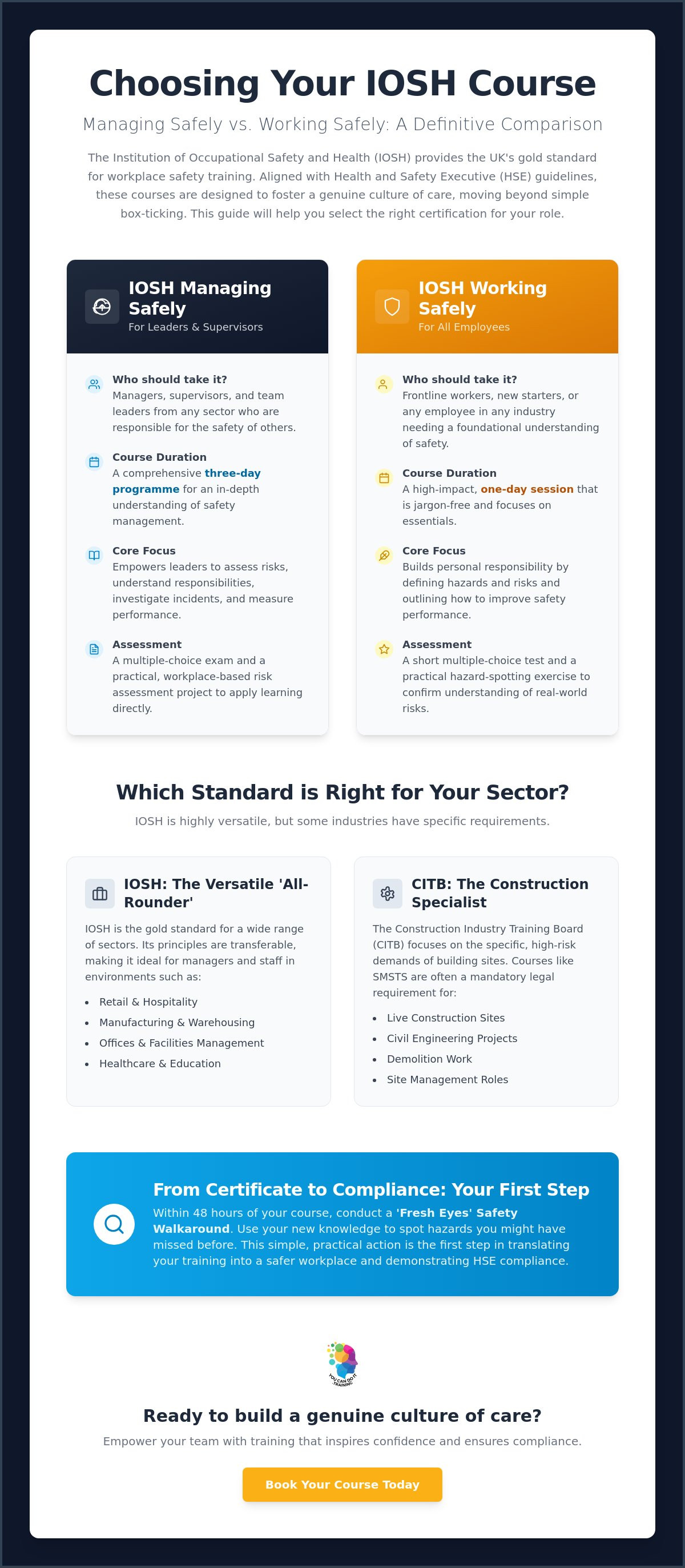
The primary distinction between iosh managing safely vs working safely lies in the level of responsibility and the depth of the curriculum. These courses are structured to meet different needs within your organisation:
Working Safely: A high-impact, one-day session focusing on personal responsibility and basic hazard awareness.
Managing Safely: A comprehensive three-day programme centred on leadership, risk assessment, and incident investigation.
The assessments also differ to reflect these roles. Working Safely uses a hazard-spotting exercise to ensure frontline staff can identify risks in real-time. Managing Safely requires a more detailed multiple-choice exam and a workplace-based project to prove you can apply management theory to your specific site. Both paths aim to dismantle the intimidation often associated with safety compliance, showing that with the right support, you can do it.
Who Should Take IOSH Working Safely?
This course is ideal for newcomers and frontline workers in any industry. It offers a jargon-free introduction to hazards, making technical details feel accessible rather than intimidating. It's the perfect foundation for building a collective "Hearts and Minds" safety culture where everyone looks out for one another. If you want your team to understand their personal impact on safety in just one day, this is the right path.
Who Should Opt for IOSH Managing Safely?
If you're a supervisor, manager, or team leader, you need the tools to organise safety and investigate incidents. This course empowers you to assess risks and take decisive action. The workplace-based project is a standout feature; it delivers immediate ROI by allowing you to improve safety on your own site before the course even ends. It's about turning a mandatory requirement into a transformative opportunity for your business leadership.
IOSH vs CITB: Choosing the Right Standard for Your Sector
Deciding between different training standards can feel like a maze, but it's simpler than you might think. IOSH is your versatile, multi-sector partner. It's the perfect fit for environments like retail, manufacturing, or facilities management where safety principles apply across the board. In contrast, the Construction Industry Training Board (CITB) focuses specifically on the high-risk, technical demands of building sites. If you work in a warehouse or an office, IOSH is your gold standard; if you're on a live build, CITB is usually the law of the land.
For those in construction leadership, SMSTS is often a mandatory requirement for site managers rather than an optional extra. However, for almost every other UK sector, the flexibility of IOSH is unmatched. When weighing up iosh managing safely vs working safely, remember that these qualifications are highly transferable. They allow you to move from a retail management role to a factory environment without losing your professional standing or your ability to protect your team.
The IOSH Advantage for Multi-Sector Managers
Managing Safely is often the preferred choice for those leading diverse teams in non-construction roles. It doesn't just teach you what to do; it explains why you're doing it. The core principles of the Health and Safety at Work etc. Act 1974 are woven into the curriculum, ensuring you understand the legal foundations of UK safety. This approach helps dismantle the intimidation of compliance, turning it into a tool for better leadership. If you're ready to step up, you can book your course and start your journey with us.
Transitioning to Site-Specific Training
Starting with IOSH Working Safely serves as an excellent stepping stone for those who might eventually move into more technical site supervisor roles. It builds the confidence and vocabulary needed to handle basic hazards before you tackle more specialised certifications. Whilst IOSH provides industry-agnostic principles suitable for any workplace, CITB sets the site-mandated standards required specifically for the UK construction sector.
The Learning Environment: Why "Hearts and Minds" Matter
Technical health and safety training often carries a reputation for being dry, clinical, and frankly, a bit intimidating. We believe that for safety behaviours to change for the long term, we must engage both the "Hearts and Minds" of every learner. Whether you are weighing up iosh managing safely vs working safely, the physical and psychological space where you learn is just as vital as the syllabus itself. It is about moving beyond the textbook to ignite a genuine passion for workplace wellbeing.
While online options offer convenience, the camaraderie and shared experiences found in a face-to-face training centre are often what lead to our 99% pass rate. There is a specific energy that comes from sitting in a room with peers, discussing real-world challenges, and realizing that "you can do it" regardless of your previous academic experience. This social atmosphere fosters a sense of achievement that a laptop screen simply cannot replicate.
Hospitality plays a surprising but essential role in dismantling the fear of exams. We find that a relaxed atmosphere, proper tea, and a steady supply of bourbon creams help students feel at home. When people are comfortable and respected, their anxiety levels drop, allowing the expert mentorship of a Chartered IOSH member to truly sink in. Our trainers understand the down-to-earth reality of your business, ensuring the advice given is practical rather than just theoretical. If you want to experience a training environment that puts you first, view our upcoming course dates here.
Actionable Tip: Choosing the Best Study Method for Your Team
To decide if your staff will thrive better in a physical or virtual classroom, use this quick checklist:
Learner Anxiety: Do your employees feel nervous about formal tests? If so, the support of a physical group is usually better.
Technical Access: Does everyone have a quiet space and a reliable connection for a full day of online study?
Team Building: Is there a need to improve communication between different departments? In-person training is a fantastic way to foster camaraderie.
Choosing a "relaxed but professional" environment is the key to overcoming learner anxiety and ensuring the information sticks long after the certificate arrives.
From Certificate to Compliance: Implementing Your IOSH Training
You've finished your course, enjoyed the hospitality, and earned your qualification. Now comes the most rewarding part: turning that knowledge into a safer workplace. The real value in the debate of iosh managing safely vs working safely is found in how you apply those principles once you're back on the shop floor. We recommend conducting a "fresh eyes" safety walkaround within 48 hours of completing your training. This allows you to spot hazards that might've become invisible over time and address them whilst your new skills are still sharp.
Translating IOSH theory into HSE-compliant documentation is your next priority. Use your course insights to update risk assessments, ensuring they reflect the specific realities of your site. You can also cascade this knowledge to the wider workforce through "toolbox talks." These short, informal briefings are a fantastic way to share Working Safely principles with those who haven't yet attended a full course, fostering a sense of shared responsibility and camaraderie amongst the whole team.
Safety is a process of continuous improvement. Once you've mastered the basics, you might identify further training needs to keep your momentum soaring. For many businesses, a natural next step is ensuring your team can handle medical crises by booking an Emergency First Aid at Work course. This builds on the "Hearts and Minds" philosophy by proving you value the physical wellbeing of your staff as much as their technical safety.
The Manager’s Post-Course Action Plan
If you've completed Managing Safely, you now have the authority to refine your organisational systems. Follow these steps to ensure a smooth transition from classroom to compliance:
Review Accident Books: Look for recurring patterns that your new risk assessment skills can help eliminate.
Audit RIDDOR Procedures: Ensure your reporting of injuries and dangerous occurrences meets current UK legal standards.
Appraisal Integration: Include safety performance in staff appraisals to encourage positive behaviour and mutual respect.
Maintaining Safety Momentum
Schedule regular safety briefings to keep the conversation going and ensure that safety never feels like a "one-off" event. This keeps the "Hearts and Minds" approach at the centre of your daily operations. Remember, an IOSH certificate is the start of a safety journey, not the destination.
Step Into a Safer Future
Choosing between iosh managing safely vs working safely is about more than just a certificate; it's about finding the right level of empowerment for your specific role. If you're a frontline worker, the one-day session builds essential personal responsibility. For those in leadership, the three-day programme provides the strategic tools to manage risk and protect your team. Both paths offer a flexible, multi-sector qualification that ensures your business stays compliant whilst fostering a genuine culture of care.
At You Can Do It Training Ltd, we've spent 30 years dismantling the intimidation of health and safety. Our courses are delivered by Chartered IOSH members who understand the down-to-earth reality of your business. We're proud of our 99% pass rate, which we achieve through a "Hearts and Minds" approach that puts you at the centre of the learning experience. By combining professional authority with warm hospitality, we ensure your training is as engaging as it is essential.
Book your IOSH course with our expert mentors today and discover how a relaxed atmosphere can ignite a lasting spark of safety in your workplace. You've got the vision to improve your business, and we're here to help you soar. Let's make your safety journey a success together.
Frequently Asked Questions
Is an IOSH certificate a legal requirement for managers in the UK?
No specific law states that you must hold an IOSH certificate, but UK health and safety regulations mandate that managers must be "competent." Holding an IOSH Managing Safely qualification is one of the most respected ways to prove to the Health and Safety Executive (HSE) that you have the necessary skills to oversee a safe workplace. It helps you meet your legal duties under the Health and Safety at Work etc. Act 1974 by providing evidence of formal training.
How long does an IOSH Managing Safely certificate last and is there a refresher?
An IOSH Managing Safely certificate does not have a formal expiry date, but IOSH strongly recommends taking a refresher course every three years to keep your knowledge current. This ensures you remain up to speed with any changes in legislation or workplace best practices. The refresher is a high-impact, one-day session designed for those who have already completed the full three-day programme, allowing you to maintain your momentum without significant downtime.
What is the pass rate for IOSH courses and is the final exam difficult?
We maintain a 99% pass rate across our accredited courses, proving that these exams aren't something to fear when you have the right mentorship. While the assessments require focus, they are designed to be practical and accessible rather than intentionally difficult. When comparing iosh managing safely vs working safely, remember that both courses use jargon-free language and hazard-spotting exercises to ensure you feel confident and empowered during the final assessment.
Can I use an IOSH Working Safely certificate to apply for a CSCS Green Card?
Yes, you can use an IOSH Working Safely certificate to apply for your CSCS Green Labourer Card. It is officially recognised as an equivalent to the Level 1 Award in Health and Safety in a Construction Environment. This makes it a fantastic, versatile option if you want a qualification that is respected across all UK industries whilst still allowing you to access construction sites. It's a great way to prove your safety awareness without needing a construction-specific course.
What is the main difference between IOSH and NEBOSH for career progression?
The main difference lies in the depth of study and your intended career path. IOSH courses are designed for managers and supervisors who need to oversee safety alongside their primary roles. In contrast, NEBOSH is a much more intensive, technical qualification intended for those who want to become full-time health and safety professionals. Choosing between iosh managing safely vs working safely is usually the first step for most leaders before deciding if they wish to soar into a specialist NEBOSH role.


Comments